A parent's guide to Quebec's competency-based approach.
Find your child's Quebec school level
TutorCraft's Quebec Education Program support spans Grades 5–10: Elementary 5 and 6, followed by Secondary I, II, III and IV. Elementary 5–6 form Elementary Cycle Three; Secondary I–II form Secondary Cycle One. The later secondary years introduce more specialized pathways. These labels matter when choosing practice: a Grade 8 selection corresponds to Secondary II, not an extra elementary year. Start with the level shown on your child's report card and the language used for that subject.
Elementary 5–6: concepts and competencies
In Elementary 5, pupils consolidate arithmetic, fractions, decimals, geometry and measurement; Elementary 6 extends their use in multi-step situations, with statistics and probability also in the mathematics program. QEP mathematics develops solving situational problems, reasoning using mathematical concepts and processes, and communicating using mathematical language. Science and technology encourages practical problem-solving and explanations. Geography, history and citizenship education helps children understand societies, territories and change, rather than simply memorize isolated dates or place names.
Secondary I–II: use knowledge in context
In Secondary I, mathematics develops number sense, proportional reasoning and introductory algebra; Secondary II extends work with equations, geometry and data. Science and technology combines investigation with understanding living things, matter, Earth and space, and technological systems. History and citizenship education explores societies and their development, while geography examines how people organize territories. Language learning asks students to interpret texts, write for a purpose and communicate orally. Arts, physical education, and Culture and Citizenship in Quebec also contribute to a balanced program.
Secondary III–IV: watch the pathway
Secondary III brings more demanding algebra, relationships, scientific explanations and work on the history of Quebec and Canada. In Secondary IV, mathematics follows a chosen sequence, such as Cultural, Social and Technical, Technical and Scientific, or Science. Science and technology courses also vary by pathway. A generic grade label cannot capture every course requirement. Ask the teacher for the exact course and current topic before selecting a worksheet, particularly when reviewing for a course examination.
Understand end-of-cycle ministry examinations
Quebec uses ministry examinations at selected milestones, not in every subject at every grade. At the end of Elementary Cycle Three, Elementary 6 examinations include mathematics and the language of instruction. A compulsory French writing examination also occurs in Secondary II in the French-language sector. Secondary IV has ministry examinations in specified subjects that contribute to certification. Requirements differ by sector and course; confirm the current year's arrangements with the school. Practice should develop reasoning and clear explanations, not claim to predict exam questions.
Support the process, not only the answer
A competency describes what a learner can do with knowledge. When working at home, invite your child to identify useful information, choose a method, show a diagram and explain why an answer makes sense. In French or English, ask what evidence supports an interpretation. TutorCraft offers lessons and printable practice to revisit individual topics, with French-language options where available. Use the answer key after an independent attempt. The teacher's evaluation framework and classroom tasks remain essential for judging broader QEP competencies.
A real worksheet preview
QEP Elementary 5: area and missing dimensions
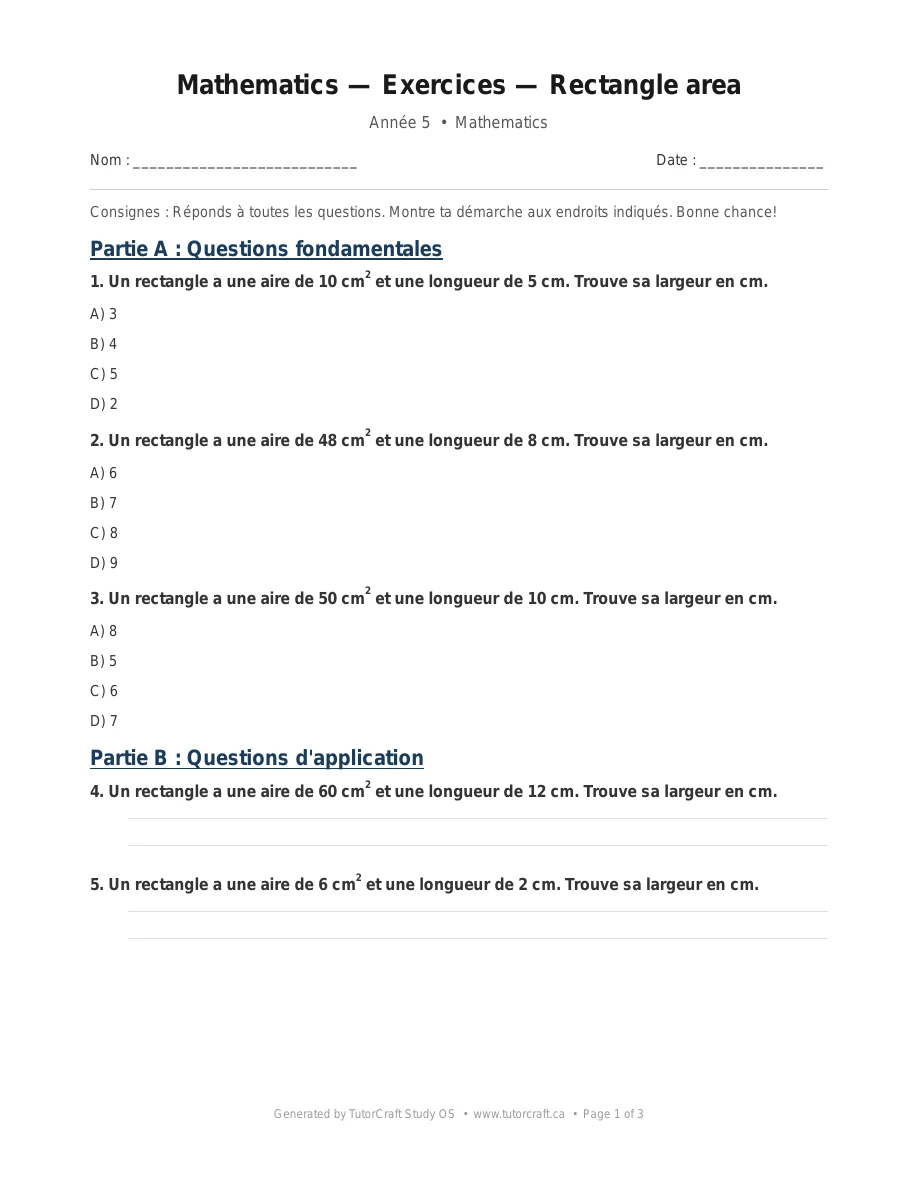
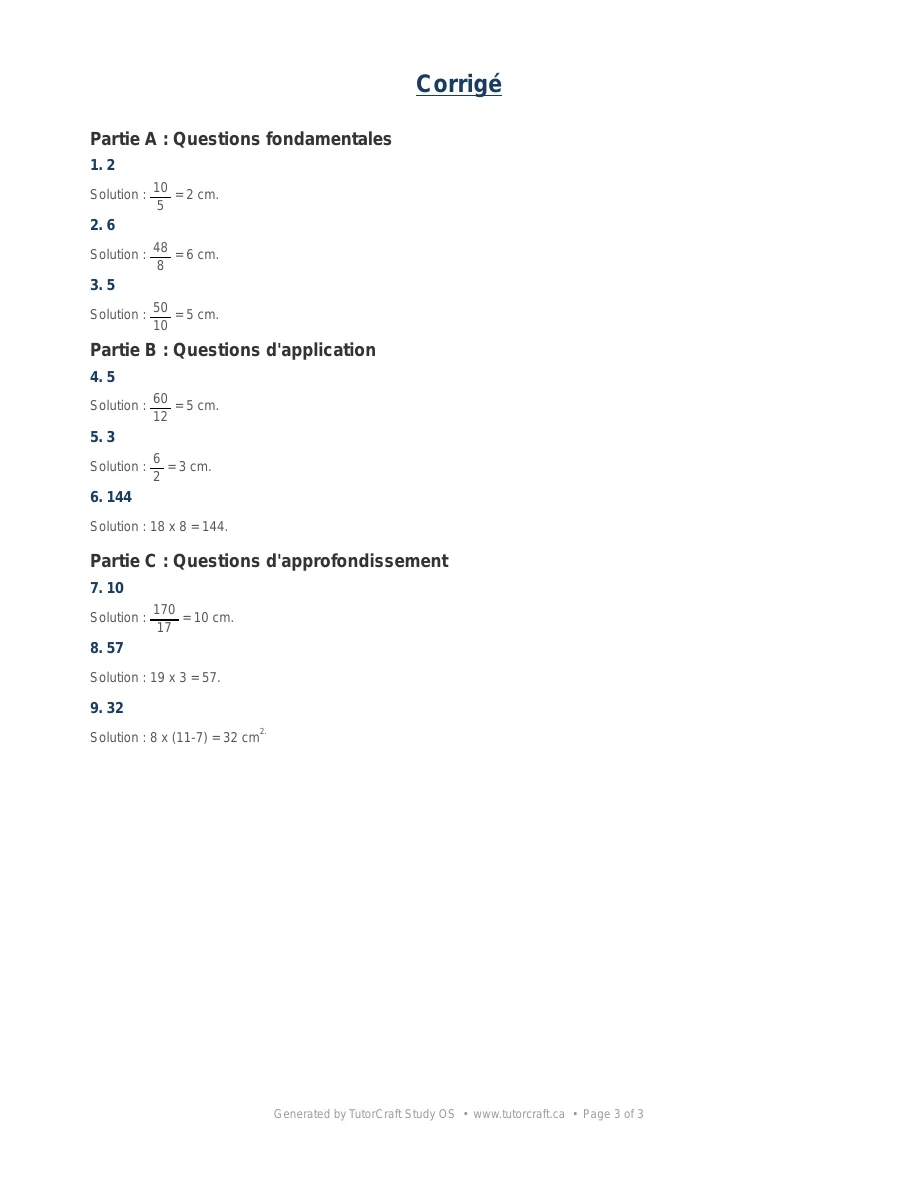
This French-language example was generated by TutorCraft for Elementary 5 mathematics. The first page and corrigé are shown together; the full PDF includes three pages. It is not a ministry examination.
Open either image for a full-size view. The complete worksheet is three pages.
01Un rectangle a une aire de 10 cm² et une longueur de 5 cm. Trouve sa largeur en cm.
Afficher la réponse
2 cm : 10 ÷ 5.
02Un rectangle a une aire de 48 cm² et une longueur de 8 cm. Trouve sa largeur en cm.
Afficher la réponse
6 cm : 48 ÷ 8.
03Un rectangle a une aire de 50 cm² et une longueur de 10 cm. Trouve sa largeur en cm.
Afficher la réponse
5 cm : 50 ÷ 10.
A few useful answers
Frequently asked questions
Is TutorCraft free for Quebec families?
The learning platform is currently free. An account gives access to the study tools; any human tutoring arrangement is separate.
How do Grades 5–10 map to Quebec levels?
Grades 5–6 mean Elementary 5–6. Grades 7, 8, 9 and 10 correspond to Secondary I, II, III and IV. Secondary V is outside this public curriculum coverage.
Does the practice follow QEP competencies?
QEP topics and terminology guide the study material. Short worksheets practise parts of a competency, but do not replace the richer classroom tasks teachers use to evaluate it.
Can my child practise in French?
TutorCraft supports English and French study experiences. Choose the appropriate language for the activity and check the generated text. The sample here is a French-language mathematics worksheet.
Are these official ministry exam questions?
No. They are independent practice activities. Ask the school which ministry examinations apply to your child's level, sector and course, and use ministry materials for official exam guidance.