TutorCraft's IB Middle Years Programme study support covers Grades 6–10, often corresponding to MYP Years 1–5. Schools can map local grades differently, so check your child's MYP year with the coordinator. Unlike a single provincial syllabus, the MYP is a framework schools combine with local requirements. It connects subject knowledge with inquiry, real-world contexts and approaches to learning: research, communication, thinking, collaboration and self-management. A useful study session builds both understanding and the ability to explain how that understanding developed.
Grades 6–7: establish subject habits
In the early years, mathematics commonly builds number, algebra, geometry, statistics and probability foundations. Sciences develops observation, investigation and evidence-based explanations. Language and literature involves interpreting and creating texts; language acquisition develops communication in another language. Individuals and societies introduces historical, geographical and social questions. Arts, design, and physical and health education complete the eight subject groups. Grade 6 may emphasize supported investigations, while Grade 7 often asks for more independent organization. Exact units and their order are school decisions.
Grade 8: connect ideas and explain choices
By Grade 8, students often tackle more complex patterns, proportional relationships, data and algebra. In sciences they plan investigations, consider variables and evaluate evidence. Individuals and societies asks them to compare perspectives and assess sources, while language assignments develop structured analysis and purposeful writing. Design work follows a process of inquiry, ideas, creation and evaluation. These are examples of progression, not a universal Grade 8 checklist: use the school's unit planner to choose the topic your child actually needs.
Grades 9–10: deepen independent learning
Later MYP study brings longer investigations, more demanding texts and stronger justification of conclusions. Mathematics may follow standard or extended expectations; scientific study may be integrated or organized into disciplines. Students apply subject knowledge in unfamiliar contexts and reflect on the quality of their work. Grade 9 is a good time to strengthen note-taking and planning; Grade 10 commonly brings the final-year Personal Project. Optional MYP eAssessment depends on school participation and is not a requirement of every study activity.
What assessment criteria A–D mean
MYP subject groups use four assessment criteria, A–D, but their names and expectations are subject-specific. In mathematics, A is Knowing and understanding, B is Investigating patterns, C is Communicating, and D is Applying mathematics in real-life contexts. Those labels must not be copied onto every subject. Read the task-specific rubric supplied by the teacher: correct calculations alone do not demonstrate all four criteria. Short practice questions build component skills; they are not a complete assessed MYP task or an official IB grade.
Support the Personal Project without taking over
In the final MYP year, students pursue a personal interest through a sustained project involving a process, a product or outcome, and a reflective report. Parents can help their child set realistic milestones, keep research notes and discuss what changed during the work. The student must own the decisions and writing, and the supervisor's guidance takes priority. Use TutorCraft to review supporting subject knowledge, not to produce assessed work for submission. Independent practice is most helpful when it strengthens the learner's own voice.
A real worksheet preview
MYP Grade 6: geometry foundations
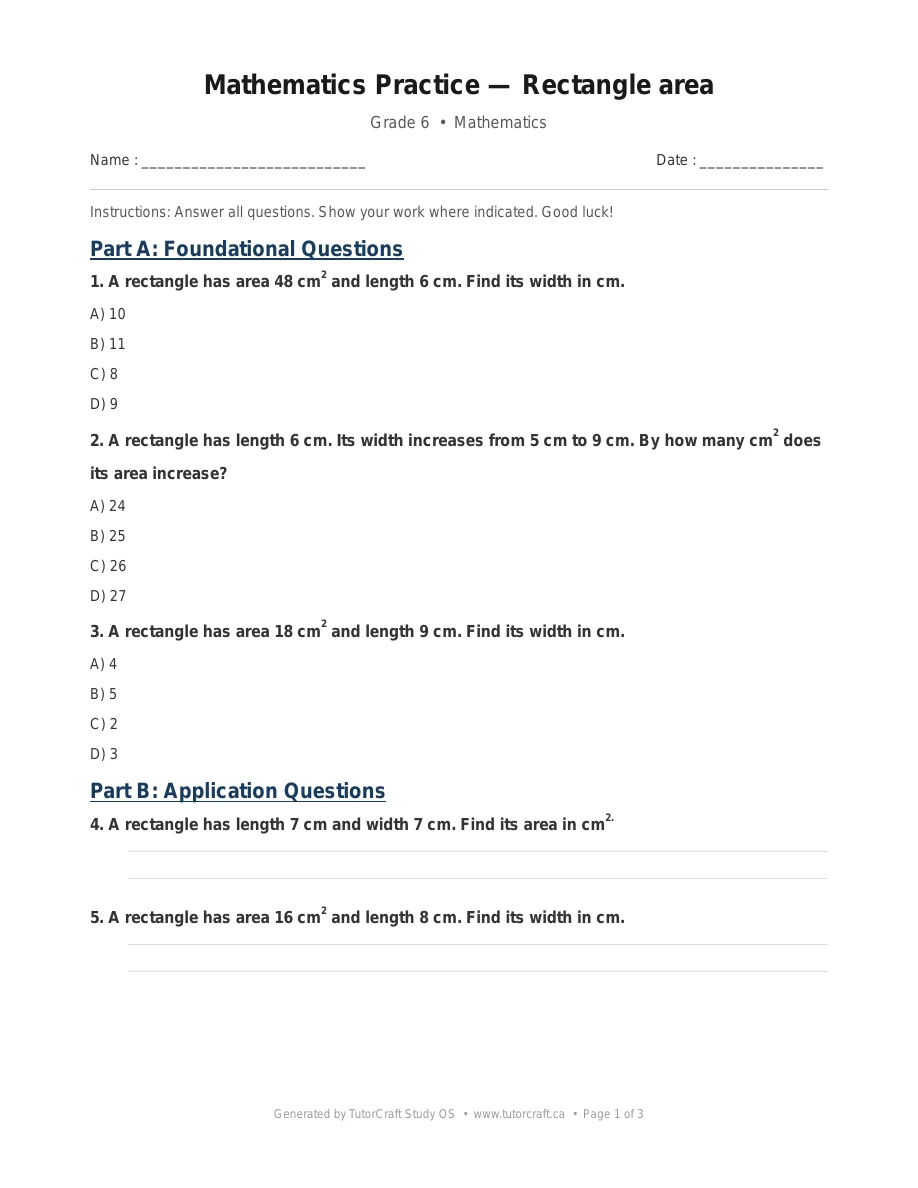
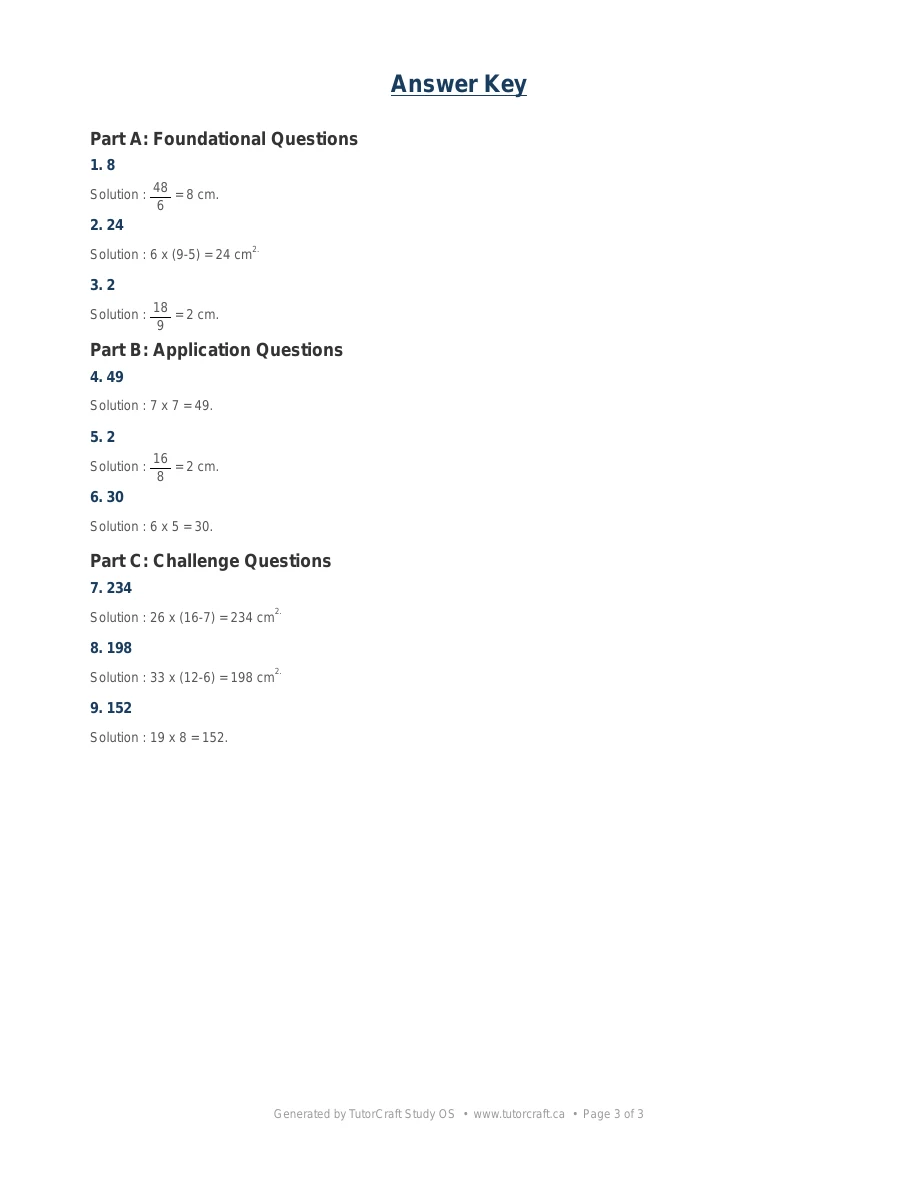
An actual TutorCraft-generated Grade 6 mathematics worksheet, with its answer key. This rectangle-area practice builds a component skill; it is not an official IB assessment or a complete criteria A–D task.
Open either image for a full-size view. The complete worksheet is three pages.
01A rectangle has area 48 cm² and length 6 cm. Find its width in cm.
Show answer
8 cm: 48 ÷ 6.
02A rectangle has length 6 cm. Its width increases from 5 cm to 9 cm. By how many cm² does its area increase?
Show answer
24 cm²: 6 × (9 − 5).
03A rectangle has area 18 cm² and length 9 cm. Find its width in cm.
Show answer
2 cm: 18 ÷ 9.
A few useful answers
Frequently asked questions
Is the IB MYP study support free?
Yes, TutorCraft's learning platform is currently free to use with an account. This is separate from any paid human tutoring service.
Which MYP years are covered?
The browser covers Grades 6–10, often MYP Years 1–5. Your school may use a different grade-to-year mapping, so confirm the correct level with the MYP coordinator.
Will the topics match my child's IB school?
The subject groups follow the MYP framework, but each school selects units and combines them with local requirements. Match practice to your child's unit planner rather than assuming identical topics at all IB schools.
Does TutorCraft award IB criterion scores?
No. Practice feedback is not an official IB criterion score. The classroom teacher evaluates assessed tasks using subject-specific rubrics, and a short worksheet cannot represent every criterion.
Can it complete the Personal Project?
No. The project must remain the student's own work. Review background concepts and practise skills here, but follow the supervisor's instructions and the school's academic integrity policy for the actual submission.